

In this article we will delve into the world of the seance room in the Victorian Era. We will peek at the link between spiritualism, magic and the repression of women.
From the 1880s medics began to pathologise spiritualism with Female Hysteria. The idea of hysteria has been somewhat trivialised by todays Internet memes. These allude to repressed women seeking sexual satisfaction with invented appliances. This representation of hysteria as something rather jolly is altogether misleading. The real truth of hysteria was far more sinister.
The Victorians believed that a woman’s womb could roam around the body. It could end up pointing the wrong way or become askew. If this was to occur, then the owner of the miscreant womb could become a deviant. Deviant behaviours included: mesmerism, socialism, spiritualism, high libido, low libido, being a general annoyance, and becoming desirous of the right to vote. The diagnosis of hysteria was an excuse to abuse and control any woman not toeing the line.
A special name was coined for women who indulged in spiritualism, a Mediomaniac (Alex Owen, The Darkened Room). Mediomaniacs indulged in depletive spiritual activity and were sexual deviants. Working in tandem with the exposers of the methods of spiritualists, medics rounded off the spiritualist female into a package of neat degeneracy.
This was a very dangerous position for the female spiritualist. Especially spiritualists whose husbands or male relatives disapproved of their drawing room antics. Women existed in the same category as criminals, lunatics and minors. Women had few legal rights. If a woman went to prison or lunatic asylum, without her husband’s agreement to release her, she would never be free. This was especially problematic if it was your husband who had incarcerated you in the first place!
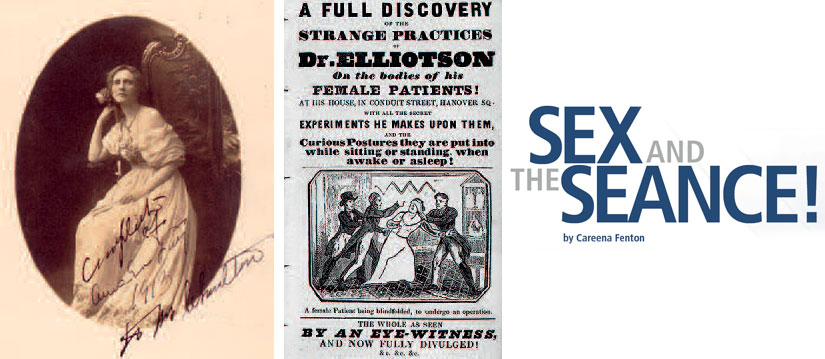
From the 1880s onwards hysteria and clairvoyance were inextricably linked for women. To avoid imprisonment, performances had to move out of the drawing room and into the well-lit theatre of safety. The first lady of The Magic Circle, Anna Eva Fay, relinquished private seances and concentrated on her music hall performances (Peter Lamont, The First Psychic). Research for my show led me into this shadowy world of Victorian spiritualism and mesmerism. I discovered that the female practitioners were not just frauds and charlatans, but also magicians finding a creative outlet. If this is so, then female spiritualists are the founding Mothers of Bizarre Theatrical Magic. One such historic example of this was Elizabeth Okey, who was the subject of the mesmerist Dr John Eliotson at University College Hospital London. Elizabeth was eager to please, good at going into trance and was an attractive young lady. Time at the hospital meant time away from her poverty-stricken home; it provided food and comfort. Under Eliotson’s mesmerist spell she also became the centre of attention. Dr Eliotson proposed that mesmerism could be used as a form of anaesthetic for surgery and set about to prove it on Elizabeth. Elizabeth did not wake from trance at the insertion of a
finger into her mouth. Nor did she wake when a fingertip touched her eyeball. The tests became more macabre, more invasive and essentially sado-masochistic. Great viewing for those fellows sat in the lecture theatre. Elizabeth and Eliotson gave a magical performance, without gimmicks or gaffs.
Elizabeth remained unflinching at the insertion of a needle through her arm. Followed by a pin under her fingernail. There is something familiar here for magicians… the classic needle through arm. When performed by a male magician it is entertaining, we admire his bravery and skill. When a female performs it, or has it performed upon her, it is transformed into an act laced with erotic overtones. The needle is inserted through the forearm with the underside displayed to the audience as is the normal visual of needle through arm. This exposes the wrist, and the wrist is known to be one of the visual cues of submissive flirtation from female to male. “I wish to submit to your dominance so I’m exposing my delicate and vulnerable wrists” (bodylanguage.com). The needle through arm effect popularised by Harry Anderson is performed by bizarre magicians around the world. The best pin under the nail effect I have seen is performed by the magician David Parr in the United States. As Elizabeth Okey’s infamy grew it must have occurred to her that the future was bleak. The tests could only become more invasive. Necessity is the mother of invention, so she put to use her quick wits and her mind. Elizabeth suddenly attained a new skill, clairvoyance. Excitingly, she was also the first woman to have ever performed a living or dead test. Elizabeth accurately predicted the death of a child seen at a window. The hospital paid very close attention, they wanted to know if this could be repeated. To stop the continued assault from a variety of medical implements, I would imagine it could.
In a coup d’etat, she called Eliotson a “damned fool” (Wendy Moore The Mesmerist). She sensationally went to the men’s ward and predicted who was to die and who was to live. It was a living or dead test using real people on the hospital ward. To enhance her predictions Elizabeth’s genius channelled into an existing climate of fear. There was a new monster roaming the country, the evil and much feared Spring Heeled Jack.
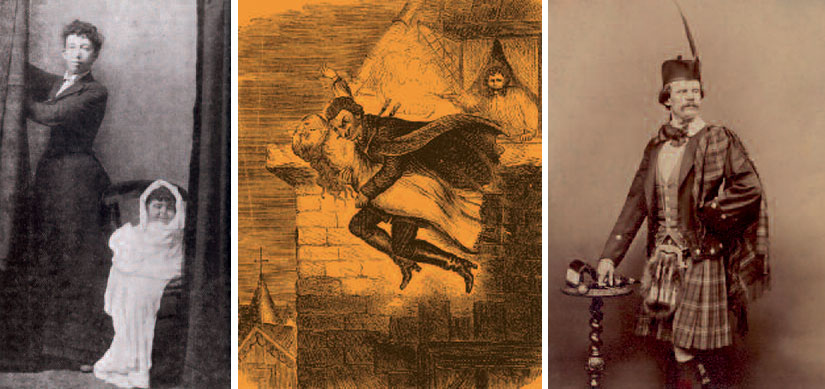
The first sighting of Spring Heeled Jack was in 1837 in London. By 1838 he was being written about in the Penny Dreadfuls and newspapers. He was an urban myth of London, a devil disguised as a gentleman with very springy shoes. He allegedly leapt very high on top of tall buildings, bounding from roof to roof; the unfortunates who saw him either turned insane or died.
On 16 August 1838 Elizabeth was led around the men’s ward at University College Hospital. She looked at the assembly of unwell men. She was then returned to the lecture theatre where a packed audience await her verdict. Elizabeth wrote her predictions and sealed them in envelopes. (An envelope in a prediction routine, who would ever have thought it!?) Her predictions revealed which men had Spring Heeled Jack standing beside them, and who were soon to die.
This is the work of an inspired genius. Elizabeth Okey tapped into the most sensational news story of the day, and used it to her own advantage. She used the public’s fear and sensationalism of Jack to make her predictions of death even more exciting. This is the predecessor of magic effects which carry the theme of a spectator using intuition to locate a corpse. For example, “Find the Dead Guy” in the first volume of The Artful Mentalism of Bob Cassidy.
After this sensational performance UCL decided it had enough of Dr Eliotson and he disappeared into obscurity, as did Elizabeth. The mesmeric craze soon gave way to the obscure and sexy antics of the seance parlour. The ladies of this world performed and held court in the darkened drawing room. Positioned as the supposed gentler sex they were receptive vessels for spirit communication. In essence, they were performing bizarre and geek magic.
Their drawing rooms became dark theatres of the macabre. Pinioned with threads, wax, and electrical circuits they would demonstrate how the spirits helped them to escape. These ladies would also create physical manifestations of their spirits.
Mary Rosina Showers was threaded through her pierced ear and tied to the chair. Yet her ‘spirit guide’ (or herself in a quick change if you prefer), walked among the drawing room guests. Mary Rosina Showers and Florence Cook were experts of both the escape and the quick change. Evidence of bizarre magical theatre in its early manifestation. For many women, the seance room was their creative outlet. It was here they could create theatre, make up stories, create magic.
Power was in the drawing room. Sitters at the seance were in their thrall, money and gifts changed hands in return for an evening’s entertainment. The ladies of the seance room achieved autonomy and infamy. They could also achieve a degree of physical contact not otherwise permitted in polite society. There was no doubt about it, seances were sexy. Mediums surrendered, were entered, possessed and seized by another (Alex Owen, The Darkened Room).They were ripe for flirtations and illicit touching.
One medium, Annie Fairlamb, channelled George, complete with a beard, who fondled lady sitters. On other days, Annie channelled Minnie, an ethereal spirit who kissed the gentlemen and aimed to please. Mediums could say and do things in trance that they couldn’t do in real life. They could assume roles and characters.
Trance mediumship was the domain of the female spiritualist. Under trance women could become their alter egos, they could channel and become anyone they wanted. It gave them an opportunity not only for creative expression but to have a voice in the male domain. The lecture tours and stage performances were allowed because it wasn’t actually the woman speaking in public, it was the spirit.
Male mediums, such as Daniel Dunglas Home, preferred to perform physical illusions. Levitation and table tipping was his forte. Erotic escapes and character-based performances were the domain of the feminine. In this article I have tried to illustrate female spiritualists as repressed, frustrated women. Not only sexually repressed within the confines of Victorian Society but creatively repressed too. Spiritualism gave women an outlet for creative and sexual expression. It also gave them power in a society where they had none. For the story of Elizabeth Okey, I have drawn from the work in Wendy Moore’s excellent book, The Mesmerist. The theory of Elizabeth as an original performer of bizarre magic is my own.
Also my own is the discovery of Springheeled Jack as the catalyst for death in Elizabeth’s predictions. A true bizarrist tale if ever there was one! For those interested in the link between hysteria and Spiritualism, I recommend Alex Owen’s The Darkened Room.